

Does SEO for social media help your search rankings, or does social media strengthen SEO? The reality is that SEO and social media work best when they support each other.
Although social media is not a direct ranking factor, it plays an important role in improving SEO performance. A strong social media presence can increase website traffic, expand content reach, support backlink opportunities, and build brand authority—all of which contribute to long-term SEO success.
For small B2B businesses, integrating SEO and social media into a single digital marketing strategy is essential. In this article, we’ll explore how SEO for social media impacts visibility, why optimising your social profiles matters, and how aligning these channels can drive more consistent, high-quality traffic to your website.
Integration of SEO and Social Media Relevance
SEO is the process of optimising your website to ensure it appears in searches performed by those looking for your product or service and then encourages people to visit your site.
Social media accomplishes exactly the same thing. It puts your business name and information in front of people who are interested in your product or service.
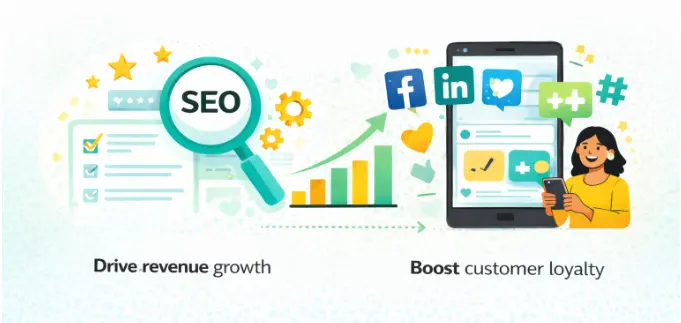
If search engines such as Google claim that they don’t take into account social media’s signals when making their search results what’s the point of it?
The answer is all the way back to the quality:
- A quality website that is engaging for its users will also be highly engaged with the social networks. Quality content can make you successful on both social media as well as SEO.
- When users interact with your website and then share it with friends on social media, it exposes your site to a wider audience. This can boost potential factors in the search engine’s algorithm, such as page views, the amount of time spent on a webpage and pages that are visited on your site and bounce rate, among others.
- The more people engage on your behalf and communicate it to their friends and followers on sites such as social media the more likely it is that you establish credibility and trust within your industry. This will help increase the quality of results for searchers.
- Quality content that people interact with on social media has an extended lifespan. One post can be shared over a long period in a row, and could be an effective lead generation tool for your business.
- The greater brand exposure you can achieve through platforms such as Facebook and Instagram, the greater chance other websites will connect to your site on their own high-quality website. Backlinks that are of high quality can aid in climbing the ranks.
Content that is of high quality will naturally get more attention from people who are more likely to share it and then link to it, including making use of social media.
When content performs well on social media, it will also receive a boost in popularity on search engines.
Let Us Take Social Media Off Your Plate From Just £100/mo →
Is SEO Affected by Social Media?
Like many aspects of marketing, the answer lies in the grey space.
Google has shared that social media posts (and the metrics associated with them) do not directly affect the location of your content on the search result page (SERP).
However, there is a direct connection between the many effects of social media posts and SEO outcomes. In the simplest sense, the use of social media in a positive way can increase the general quality of your visibility and the quality of your content that can have a direct impact on SEO.
How Social Media Helps SEO
How does social media affect SEO? SEO on social media can benefit B2B SEO in a variety of ways.
Extend the Reach of Your Posts
Sharing SEO content via social media platforms such as LinkedIn, Facebook, or Instagram can also increase the reach of your content.
Don’t limit your content to search engine results alone. Social media allows interested users to discover, read, share, and engage with your content across multiple platforms.
SEO for social media also delivers measurable benefits, including increased website traffic and stronger backlink opportunities.
Boost Traffic Coming to Your Website
Social media is a great way to increase your site’s traffic through posts that promote your website’s content.
From your most recent blog post to your most detailed tutorial, social media will successfully guide users to your website, even if they were not actively searching for these topics on Google.
When posting content on social media platforms, here are some ways to maximise your success:
- Focus on the value the content can bring to your followers.
- Use a conversational tone.
- Include a custom graphic.
When you post, make sure to examine your engagement metrics, such as likes and comments. If you receive responses to your post, respond! Social media is fundamentally a platform for conversation. Engaging with your followers demonstrates that your company values their time.
Grow Your Collection of Trusted Backlinks
SEO for social media will also help to enhance the quality of your backlink profile.
Backlinks are a crucial ranking factor in search engine optimisation, and businesses naturally focus on attracting links from trusted and authoritative websites within their field. However, getting backlinks is not a simple task.
You must have original content that is distinctive to earn a top-quality backlink.
Because of its extensive reach, social media increases your chances of gaining reliable backlinks to your website. From organic content to posts that are ‘boosted’ (paid promotion), it helps people discover your original material even if they are not actively searching for it via search engines.
To make this strategy successful, you need useful, high-quality material that is captivating and distinctive.
Raise Your Brand’s Online Presence
The influence of social media on SEO also extends directly to brand recognition. One of the most important applications of social media is precisely the creation of this awareness. Through social media, you can build visibility that will lead to more online searches for your company and its products.
In this scenario, social media actively feeds your search engine SEO strategy.
You can boost the social media benefits you gain from paid advertisements. For example, you can increase the promotion of your posts to reach people who have similar interests to your current followers. This will increase your following, brand recognition, and the overall number of visitors to your website.
Make Your SEO Strategy More Effective
Social media also aids your SEO efforts by influencing your overall SEO content strategy.
Based on your most successful posts, you will be able to determine what topics are most popular with your audience and what they are looking to know more about within your field.
Naturally, you will need to verify that these subjects have a high search rank potential, as you will rely on search traffic to drive volume over time. SEO tools such as Keywords Everywhere, Google Keyword Planner, Ahrefs, and Semrush will all be helpful in this verification process.
Appear More Often in Local Search Listings
Businesses can significantly boost their local search presence by optimising their social media profiles. Some companies classify local listings, such as Google Business Profile, as a form of social media because they allow you to communicate directly with users via these platforms through reviews or postings.
If you have an optimised profile, you are more likely to appear in local or branded search results. For prospective clients, seeing your company’s name appear on multiple occasions, especially on professional social media profiles, helps to verify that your company is legitimate and reliable.
Optimised Platform Strategies to Support SEO
While the preceding points cover the main concepts regarding how utilising social media will aid SEO in 2026, there are also specific platform strategies you can apply to make use of your social media channels more effectively.
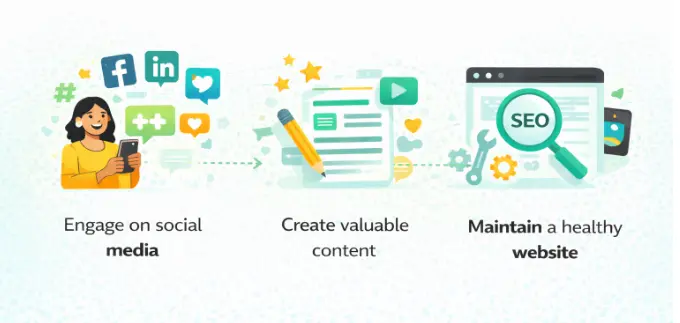
This, in turn, will boost your SEO, brand awareness, and traffic to your website:
As a professional network, LinkedIn is an excellent option for building brand awareness and establishing yourself as an industry expert, which directly influences your search rankings. The public nature of LinkedIn content can influence AI models as well as social search outcomes for businesses.
How to Leverage It:
- Optimisation of your Company’s Page: Update your company’s profile with a pertinent headline and description, logo, and banner image.
- Thought Leadership Content: Distribute industry research, articles, and thought leadership material, using specific keywords and ensuring you link back to your website.
- Collaborate: Partner with leaders in the industry and other groups to increase reach and involvement.
Get Our FREE LinkedIn Post Templates Toolkit →
Facebook helps to build an impressive community and drives visitors back to your site via both organic posts and paid advertisements, leveraging its network of more than 2 billion active daily users within the Meta ecosystem.
What is the best way to use it:
- Groups: Create Groups or Join relevant Facebook Groups and post high-quality, engaging content that has the potential to be shared with a large audience.
- Facebook Ads: Create targeted Facebook ads to direct traffic to specific landing pages on your site.
Instagram plays an important part in promoting your brand’s profile and driving traffic to your site. With content that is public and professional now being indexable by Google, captions and alt texts can affect cross-surface search results.
What is the best way to use it:
- Optimise Captions: Make use of relevant keywords and strategically chosen hashtags to promote engagement.
- Video and Image SEO: Include descriptive alt text on videos and images, using appropriate keywords.
- Collaborations: Partner and work with influencers to increase your SEO, social, and media influence.
Optimising Your Social Media Profiles for SEO
Taking effective, measurable steps to boost your social channels’ visibility in the Search Engine Results Pages (SERPs) does not require a complete brand overhaul or massive changes. The precise optimisation process, however, may vary slightly across different networks.
Below are several straightforward yet highly impactful methods for improving your SEO and social media:
Specific Network Tips
Each social media platform has its own set of unique best practices for optimisation. For instance, Facebook allows you to secure a custom URL and add relevant categories to your business page.
On LinkedIn, you should strategically weave your industry and brand keywords into your Company Page’s headline, summary, job titles, job descriptions, and the skills section.
Consistent Naming and Handles
Wherever possible, adopt the same social media handle across all your profiles. This consistency is vital for reinforcing brand recognition and seamlessly tying your accounts together.
Use the identical profile picture (such as your company logo) for instant recognition, and pursue profile verification to enhance your brand’s credibility and trustworthiness.
Keyword Inclusion in Bios
Make it a priority to naturally incorporate industry-specific and brand keywords into the bio section of every profile. To further increase your visibility within the platform itself, consider including your branded hashtag in your bio as well.
Strategic Linking
Your profile bios should always feature relevant links, most importantly a link back to your primary website, to funnel traffic directly from your social channels.
You may also choose to add links to a specific lead generation form or your other key social profiles.
Alt Text for Accessibility and SEO
Adding descriptive alt text to your social media images is crucial, as it helps search engines interpret the content of your visuals, which is beneficial for SEO. Many major social networks now allow users to add custom alt text to posts.
This feature not only adds an extra layer of search visibility but also vastly improves accessibility, thereby extending your potential reach.
Final Thoughts on SEO for Social Media
The strong, complementary relationship between SEO and social media highlights the evolving and interconnected nature of today’s digital landscape. SEO for social media is no longer a secondary consideration; it is an essential part of building visibility, authority, and long-term search performance.
Whether social media can support SEO is no longer a theoretical question. It is a practical opportunity for businesses willing to take a strategic approach. By recognising the combined impact of social signals, content sharing, link-building opportunities, social bookmarking, and paid social promotion, businesses can strengthen their overall search presence and drive more sustainable growth.
Next Steps
Join a demo with 100 Pound Social to see how our affordable social media marketing and LinkedIn lead generation services can help you start 2026 stronger, from just £100 per month.